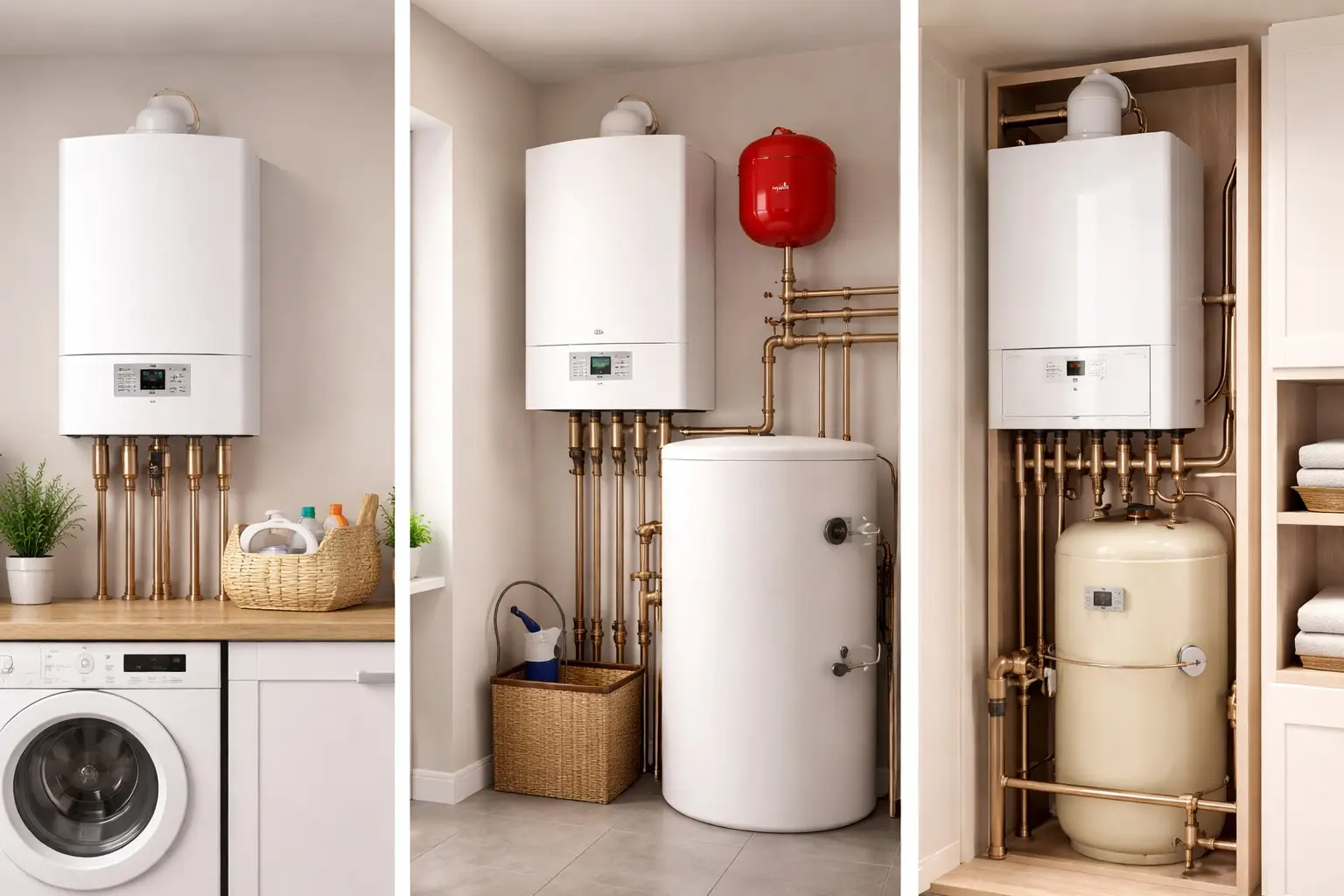
Choosing a new boiler is one of the most important decisions a homeowner can make. Get it right and you’ll enjoy reliable heating, lower energy bills, and hot water on demand for the next 10–15 years. Get it wrong and you could find yourself with an undersized system that can’t keep up with your household’s demands, or one that’s simply not suited to your property.
The three main types of boiler available in the UK are the combi boiler, the system boiler, and the conventional (regular) boiler. Each has its own advantages, drawbacks, and ideal use cases, and the right choice depends entirely on the size of your home, your hot water usage, and your existing heating infrastructure.
In this guide, the Gas Safe registered engineers at Cathedral Gas Services in Coventry break down everything you need to know about combi boiler vs system boiler vs conventional boiler — so you can make the right choice with confidence.
Our Gas Safe engineers in Coventry offer free, no-obligation boiler consultations. We’ll assess your property and recommend the best boiler for your home and budget.
Call Us Free: 07389 111 999
Here’s a side-by-side overview before we dive deeper into each boiler type:
Combi Boiler | System Boiler | Conventional Boiler | |
|---|---|---|---|
Hot water cylinder | Not required | Required | Required |
Cold water tank | Not required | Not required | Required |
Best for | 1–2 bed homes | 2–4 bed homes | Large homes / old systems |
Multiple showers | Limited | Yes | Yes |
Installation space | Minimal | Moderate | More space needed |
Energy efficiency | High (A-rated) | High (A-rated) | Lower (older models) |
Installation cost | £1,500–£2,500 | £2,000–£3,500 | £1,800–£3,000 |
Mains pressure water | Yes | Yes | No — tank-fed |
Ideal for upgrading | Flats & small homes | Families | Large/rural properties |
A combi (combination) boiler is the most popular boiler type in the UK, accounting for roughly 70% of all new boiler installations. It is a single, compact unit that provides both central heating and instant hot water on demand, without the need for a separate hot water cylinder or cold water storage tank.
When you turn on a hot tap, the combi boiler heats the water directly from the mains supply, delivering it at mains pressure. This means no waiting for a cylinder to reheat and no running out of hot water, as long as you’re not using multiple outlets at the same time.
A combi boiler is the ideal choice for flats, one or two-bedroom homes, and smaller properties with one bathroom and low-to-moderate hot water demand. It is also an excellent option for anyone upgrading from an older system and looking to free up airing cupboard space.
A system boiler (also known as a sealed system boiler) works similarly to a conventional boiler in that it stores hot water in a dedicated hot water cylinder. However, unlike conventional boilers, system boilers take their water supply directly from the mains, meaning there is no need for a cold water storage tank in the loft.
The key components of the heating system, including the expansion vessel and pump, are built into the boiler unit itself, making installation cleaner and more straightforward than a conventional setup.
A system boiler is the best choice for medium to large family homes with two or more bathrooms and consistent high hot water demand. If your household regularly runs multiple showers or baths, a system boiler with an appropriately sized cylinder will serve you far better than a combi.
We install all major boiler types, combi, system, and conventional, across Coventry, Nuneaton, Warwick, Leamington Spa and Rugby. Get a free, no-obligation quote today.
07389 111 999 | ✉ info@cathedralgasservices.co.uk
A conventional boiler, also referred to as a regular, traditional, or heat-only boiler — is the oldest of the three boiler types. It requires both a hot water storage cylinder (usually in an airing cupboard) and a cold water feed tank (usually in the loft) to operate.
The boiler heats water that is stored in the cylinder and distributed through the central heating system via a feed and expansion tank. Conventional boilers are common in older UK properties and are often the original system found in homes built before the 1990s.
A conventional boiler is best suited to larger, older homes that already have a conventional system in place, properties with multiple bathrooms and high simultaneous hot water demand, and homes in areas where mains water pressure is low. It can also be a cost-effective option when replacing an existing conventional boiler on a like-for-like basis, as the pipework and tanks are already in place.
When weighing up combi boiler vs system boiler, or comparing either against a conventional model, the right answer depends on your individual circumstances. Here’s a practical summary to help guide your decision.
Cost is always a key factor when choosing a new boiler. Here is a general guide to what you can expect to pay for each boiler type, fully installed by a Gas Safe registered engineer:
Note: These are approximate ranges and the actual cost will vary depending on the boiler brand, the complexity of the installation, the condition of existing pipework, and your location. At Cathedral Gas Services, we always provide a full, transparent quote before any work begins — with no hidden charges.
As part of our boiler buying guide advice, we always recommend choosing a boiler from a reputable, established manufacturer. The brands we install and service most frequently at Cathedral Gas Services include:
Our engineers can advise on the best model for your home, budget, and long-term energy goals. All installations are carried out to the highest standard and are fully Gas Safe compliant.
Whether you’ve decided on a combi, system, or conventional boiler, or you’d like an expert recommendation, our Gas Safe engineers are ready to help. We serve Coventry, Nuneaton, Warwick, Leamington Spa, Rugby and surrounding areas.
Find answers to common questions about our services
A combi boiler heats water on demand directly from the mains and does not require a hot water cylinder or cold water tank — making it compact and cost-effective for smaller homes. A system boiler stores hot water in a dedicated cylinder, making it capable of supplying multiple bathrooms and hot taps simultaneously — better suited to larger family homes.
Modern combi and system boilers are both highly energy efficient, typically achieving A-rated efficiency of 90%+. Conventional boilers — particularly older models — tend to be less efficient. Regardless of the type, upgrading from an old G-rated boiler to any modern condensing boiler will significantly reduce your heating bills.
Yes, it is possible to convert from a conventional system to a combi boiler, but it involves removing the cold water tank from the loft and the hot water cylinder, as well as some pipework modifications. The cost of this conversion is higher than a like-for-like replacement, but many homeowners find the space savings and simplicity well worth it. A Gas Safe engineer can assess your property and advise on feasibility.
A straightforward combi boiler replacement typically takes one day. A system or conventional boiler installation — particularly if a new cylinder is being fitted — may take one to two days. Conversion from one boiler type to another (e.g. conventional to combi) can take two days depending on the extent of the pipework changes required.
Yes. Cathedral Gas Services are Gas Safe registered engineers based in Coventry. We install combi, system, and conventional boilers across Coventry, Nuneaton, Warwick, Leamington Spa, Rugby and all surrounding areas. We carry all major brands and offer free, no-obligation quotes with full transparency on pricing before we start.