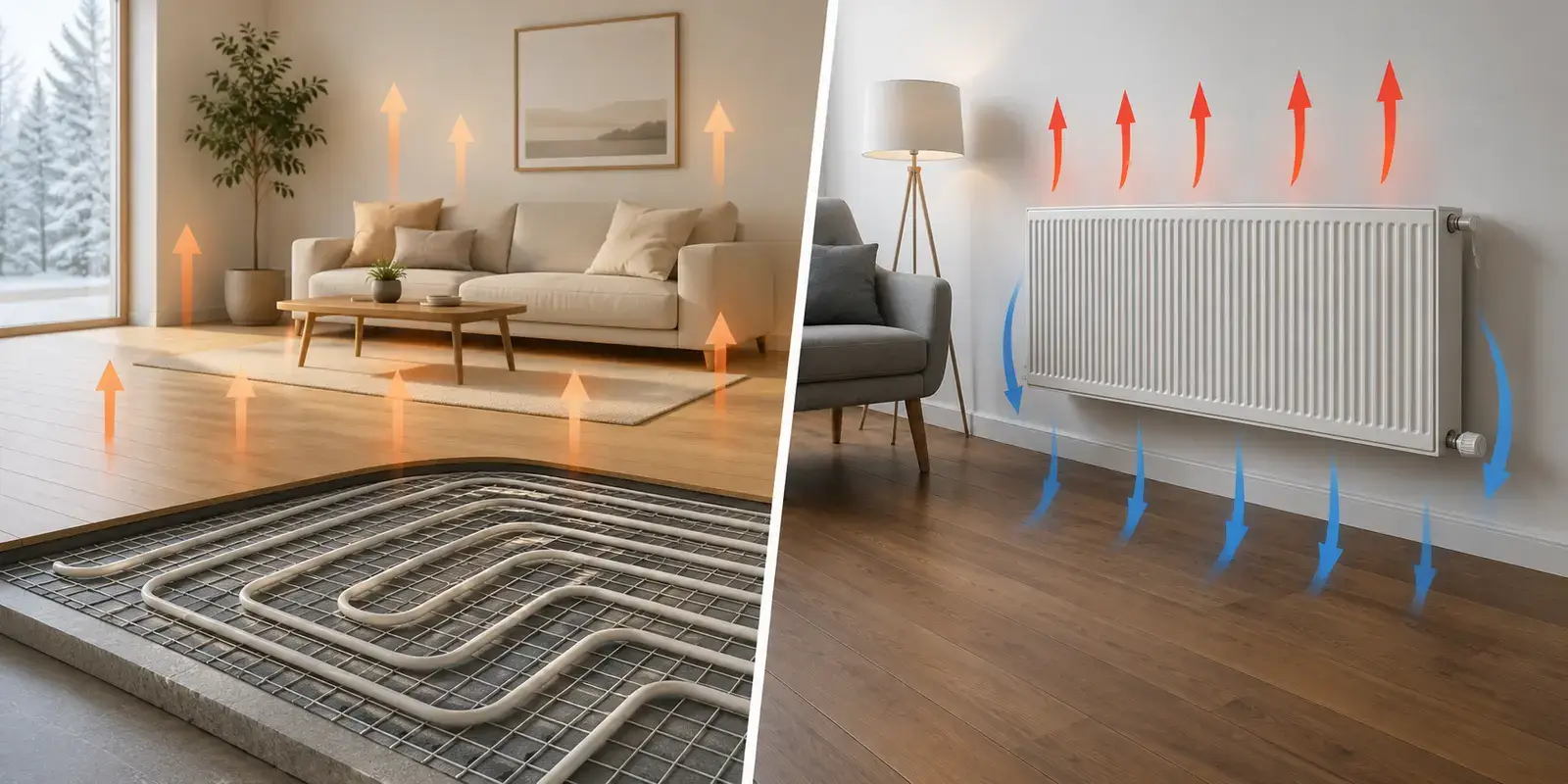

If you’re upgrading your heating system or building a new home, one question almost always comes up: should you go for underfloor heating or radiators? Both have their merits, but when it comes to energy efficiency, running costs, and long-term comfort, the two systems perform very differently. In this guide, we break down everything UK homeowners need to know, from how each system works to what you’ll realistically spend.
Our Gas Safe engineers in Coventry specialise in professional UFH installation, wet and electric systems for new builds and retrofits.
Radiators are part of a wet central heating system powered by a boiler. Hot water is pumped through pipework to radiators located on walls around your home. They heat rooms through a combination of radiation and convection, warming the air near the unit, which then rises and circulates around the space.
Radiators operate at flow temperatures of 60–80°C, meaning your boiler has to work hard to reach and maintain those temperatures. While modern condensing boilers are significantly more efficient than older models, the high operating temperature remains a fundamental limitation on overall system efficiency.
Underfloor heating warms your home from the ground up. A network of pipes or electric heating elements is installed beneath your floor surface, creating a large, even radiant heat source that gently warms the entire room from below.
There are two main types:
This is where wet underfloor heating has a clear advantage. UFH systems only require water temperatures of 35–55°C, significantly lower than a radiator system. This makes UFH highly compatible with heat pumps, which operate most efficiently at low flow temperatures. Lower operating temperatures mean less energy is needed to heat your home, which translates directly into lower bills.
Underfloor heating distributes warmth uniformly across the entire floor area, eliminating cold spots and reducing heat stratification, the tendency of warm air to rise to the ceiling. Radiators, by contrast, create hot spots near the unit and rely more on convection, which can result in uneven temperatures and wasted heat near the ceiling.
Studies from the Energy Saving Trust indicate that UFH can be up to 25% more energy efficient than traditional radiator systems when paired with a modern heat pump or condensing boiler, primarily due to the lower operating temperatures and more even heat distribution.
One area where radiators still hold an advantage is response time. Radiators heat up and cool down quickly, making them more responsive to thermostat changes. Wet underfloor heating has a much longer warm-up time, typically 1 to 3 hours, meaning it works best when left running at a consistent temperature rather than being switched on and off.
Electric underfloor heating responds faster than wet systems and is better suited for targeted, short-burst use in bathrooms or kitchens, though it is generally more expensive to run per unit of heat produced.
Need Help Choosing the Right Heating System?
Our experienced engineers can assess your property and recommend the most energy-efficient heating solution for your budget and lifestyle.
One of the biggest considerations for UK homeowners is upfront installation cost versus long-term running savings.
Wet UFH is more expensive to install but cheaper to run. Typical costs in the UK:
Because wet underfloor heating operates at lower temperatures and covers a larger surface area, it is typically 15–25% cheaper to run than radiators when connected to a modern condensing boiler, and even more efficient when paired with a heat pump. Electric underfloor heating, while cheaper to install, can cost more to run if used as a whole-house solution, as electricity is more expensive per unit than gas.
Radiator systems, in comparison, have relatively low upfront costs — a standard radiator installation ranges from £150–£500 per unit including fitting — but the higher operating temperatures mean higher energy consumption over time.
If your property currently has poorly performing radiators, it may be worth considering a radiator repair or upgrade in Coventry as a more cost-effective short-term solution before committing to a full underfloor heating installation.
Not all floor coverings work equally well with underfloor heating. The best options for heat transmission are:
Thick carpets and rugs can act as insulation against the rising heat, reducing efficiency. If you’re planning to keep carpeted rooms, radiators may actually be the more practical and energy-efficient choice in those specific spaces. A hybrid approach, underfloor heating in tiled or hard-floored areas, radiators in carpeted bedrooms, is a popular solution in many UK homes.
For homes with a gas-powered heating system, ensuring your boiler repair and installation in Coventry is carried out by a qualified Gas Safe engineer is essential to get the most from either heating system.
The honest answer: it depends on your home, budget, and how you use your heating.
Underfloor heating is the better long-term investment for new builds, major renovations, or homes moving to a heat pump system. It offers superior comfort, cleaner aesthetics, and genuine running cost savings over time. Wet UFH is the gold standard for whole-house energy efficient heating.
Radiators remain a practical, cost-effective choice for retrofit projects, rental properties, or any situation where minimising disruption and upfront costs is the priority. With the right boiler and smart controls, a modern radiator system can still be very efficient.
For most homeowners, the sweet spot is a combination of both — underfloor heating in hard-floored living areas and kitchens, with radiators in bedrooms or rooms where carpets are preferred.
Find answers to common questions about our services
Generally yes — wet underfloor heating can be 15–25% cheaper to run than radiators when paired with a modern condensing boiler, and even more efficient with a heat pump. Electric underfloor heating may cost more per unit of heat than gas-powered radiators, so it is best used in specific rooms rather than as a whole-house solution.
Yes, though a retrofit can be more disruptive and expensive than installing UFH in a new build. Wet underfloor heating requires lifting floor coverings and raising floor heights slightly. Electric systems are thinner and easier to retrofit, particularly in bathrooms or kitchens during a refurbishment.
Wet underfloor heating (also called hydronic UFH) uses a network of water-filled pipes laid beneath your floor. Warm water from your boiler or heat pump circulates through these pipes at low temperatures (35–55°C), warming the floor and radiating heat upwards into the room.
UFH works best with tiles, stone, and engineered hardwood. Thick carpets insulate against the heat rising from the floor, reducing efficiency. If you plan to keep carpets in most rooms, radiators may be a more efficient option in those areas.
In most cases, yes — a properly designed wet UFH system can heat an entire home without any radiators. However, you need adequate insulation and a correctly sized system. Many homeowners opt for a hybrid approach, using UFH in main living areas and radiators in bedrooms.
Electric underfloor heating costs more per unit of heat than gas-powered systems because electricity is more expensive than gas. It is most cost-effective in small areas like bathrooms or as supplementary heating rather than a primary whole-house heating solution.
Radiator sludge (magnetite) is primarily made up of corroded iron and steel particles from inside your pipes and radiators, combined with limescale and other debris. Over time, these particles clump together into a thick, dark sludge that settles at the bottom of radiators.
If your radiators are old (15+ years), severely corroded, or physically damaged, replacement may be more cost-effective than a flush. However, if they are structurally sound, a power flush can restore performance to near-new levels. A Gas Safe engineer can advise on the best option for your system.