Boiler pressure low means the gauge reads below 1 bar when the heating is off and the boiler is cold. The most common causes are a leak, a recently bled radiator or a faulty pressure relief valve. To fix low boiler pressure, top it up to 1 to 1.5 bar using the filling loop. If it keeps dropping, call a Gas Safe engineer.
Boiler pressure low is one of the most common reasons a boiler stops heating a home, and it usually shows up in the coldest weather. This guide explains what normal pressure looks like, why it drops, how to repressurise your boiler safely and when to call a Gas Safe engineer in Coventry.
Most sealed-system boilers, including combi and system boilers, run at 1 to 1.5 bar when the system is cold. When the heating is on, the pressure rises slightly, usually to around 1.5 to 2 bar, because the water expands as it heats up. Check your boiler manual, as the ideal figure can vary slightly by make and model.
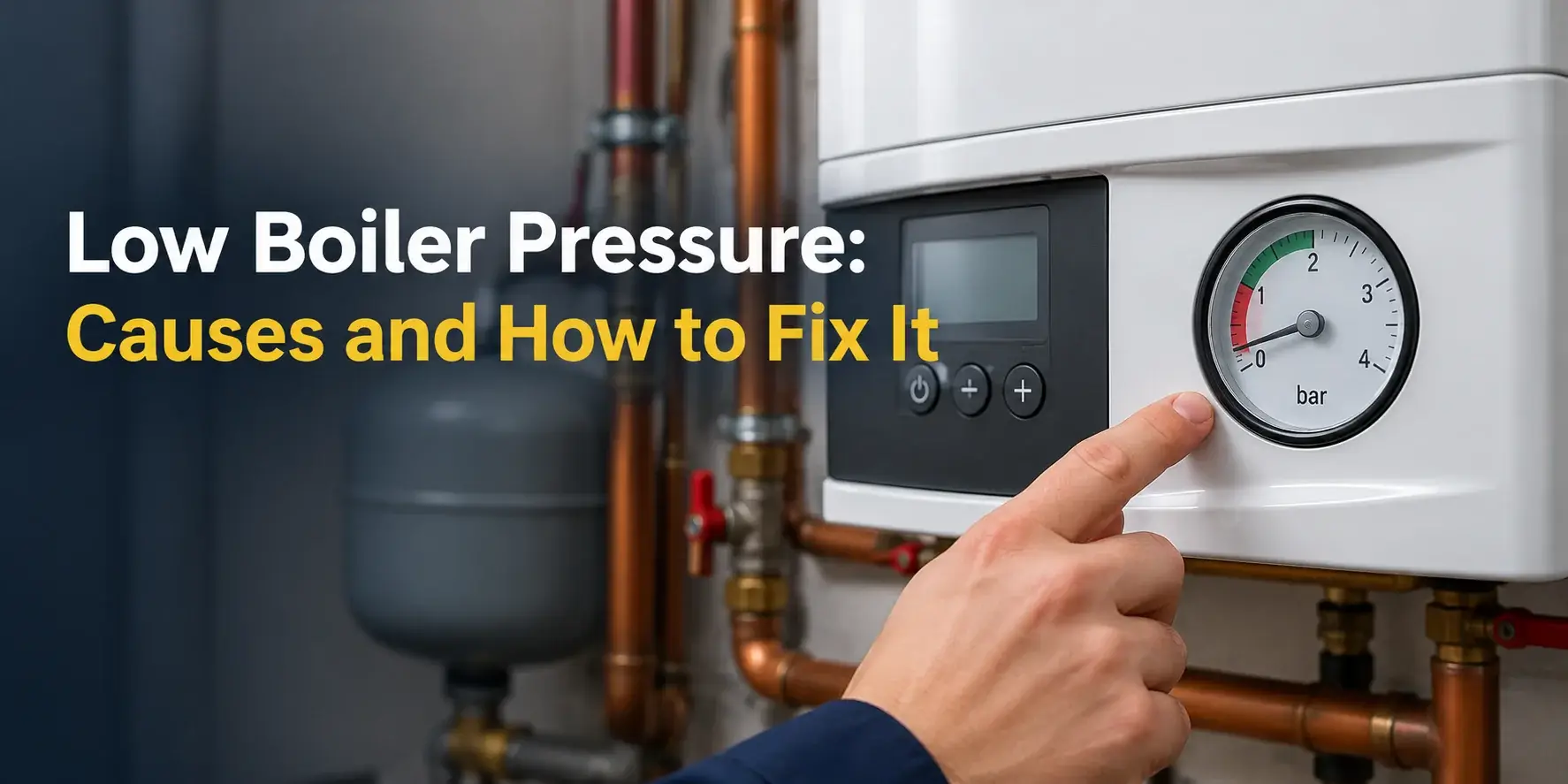
The pressure gauge on the front of the boiler is usually marked with a green zone for the safe range and a red zone for pressure that is too low or too high.
Gauge reading (cold system) | What it means | What to do |
|---|---|---|
Below 1 bar | Low pressure. The boiler may lock out | Repressurise using the filling loop |
1 to 1.5 bar | Normal | Nothing |
1.5 to 2 bar | Normal when the heating is running, slightly high when cold | Keep an eye on it |
Above 2.5 to 3 bar | Too high | Switch off and call an engineer |
The needle dropping into the red or below 1 bar is the clearest sign, but you may also notice:
The five most common causes of low boiler pressure are a recently bled radiator or maintenance work, a leak in the system, a faulty pressure relief valve, a failed expansion vessel and an internal boiler leak.
Bleeding radiators lets trapped air out, but a little water goes with it. Removing a radiator or draining the system has the same effect. This is the most common harmless reason for a pressure drop, and a quick top-up usually fixes it.
A leak is the most common cause of pressure that keeps falling. Look for damp patches, drips or water stains around radiator valves, pipe joints, the boiler itself and any exposed pipework. Some leaks are slow and hidden under floors, which is why a professional pressure test is often needed.
The pressure relief valve (PRV) releases water if pressure gets too high. If it is worn or stuck partly open, it can drip continuously and drain your system. A wet patch or drip from the external discharge pipe outside your home is a warning sign.
The expansion vessel absorbs the extra water volume as your heating warms up. If it loses its air charge or the diaphragm splits, the pressure can spike, force water out through the PRV and then drop sharply once the system cools.
A leak inside the boiler, such as a corroded heat exchanger or a failed internal seal, can drain the system from within, and there may be no visible water outside. This is a job only a Gas Safe registered engineer can diagnose and repair.
Most combi and system boilers have a filling loop, a flexible braided hose or a built-in tap that connects the mains water to the heating circuit. Check your manual first, as some models differ. Never open the boiler casing or work on any gas components yourself.
If your boiler is already over-pressurised, don’t try to fix it yourself. Switch it off and call an engineer.
Topping up the pressure is a temporary fix, not a repair. Call a Gas Safe registered engineer if:
Repeatedly refilling the system pulls in fresh water, which brings extra oxygen and limescale into your heating circuit and can speed up corrosion. It also hides a fault that could get worse.
If your heating has failed completely or you suspect a leak inside the boiler, our emergency boiler repair in Coventry service is available 24/7.
[CALL AN ENGINEER: 07389 111 999]
You can’t prevent every fault, but a few habits reduce the risk:
If your boiler is more than 10 to 15 years old and keeps losing pressure, it may be worth comparing the cost of repeated repairs with a replacement. Our boiler repair and installation in Coventry team can give you an honest recommendation.
Find answers to common questions about our services
Normal boiler pressure is 1 to 1.5 bar when the system is cold. When the heating is running, it rises to around 1.5 to 2 bar as the water expands. Always check your boiler manual, as the ideal range can vary slightly between manufacturers and models.
Boiler pressure is low when the gauge reads below 1 bar on a cold system. Many boilers stop firing or show a fault code once pressure falls much below this, because running with too little water can overheat the boiler and damage the heat exchanger.
Boiler pressure that keeps dropping almost always means water is escaping. The usual culprits are a leaking pipe or radiator valve, a faulty pressure relief valve, a failed expansion vessel or an internal boiler leak. If you have only just bled a radiator, a single drop is normal and a top-up fixes it.
Bleeding releases trapped air and a small amount of water, so the pressure drops slightly. Top it up to 1 to 1.5 bar using the filling loop. If the pressure falls again soon afterwards, there is probably a separate fault, such as a leak, and you need an engineer.
Losing pressure overnight or as the system cools usually points to a failing expansion vessel, a slow leak or a pressure relief valve that is not sealing properly. As the water cools and contracts, a fault makes the drop easier to see. Ask an engineer to pressure-test the system.
Many boilers show a code when water pressure is too low, for example F1 on some Ideal models, F22 on Vaillant and 118 on Baxi. Codes vary by make and model, so check your manual. Top up the pressure and reset once. If the code returns, call a Gas Safe engineer.
Running a boiler with low pressure can cause overheating and damage the heat exchanger and pump, which is why most modern boilers lock out automatically. Low pressure is not a gas safety risk in itself, but avoid forcing repeated restarts.
Yes. Most homeowners can safely use the filling loop, following the steps above and the boiler manual. A healthy system needs topping up only once or twice a year at most. Never open the boiler casing or touch gas components, as only a Gas Safe registered engineer can do that legally.
Not for a simple top-up. You do need a Gas Safe registered engineer for any repair on the boiler itself, such as replacing a pressure relief valve, expansion vessel or heat exchanger. In Coventry, Cathedral Gas Services' engineers are on call 24/7 on 07389 111 999.
It is not dangerous in itself, but it can leave you without heating and hot water, and a leak can cause water damage. If you can see water leaking or the boiler will not restart after one top-up, treat it as urgent and call an engineer.
The cost depends on the cause. A top-up is free, while replacing a pressure relief valve, expansion vessel or leaking component costs more. A Gas Safe engineer will diagnose the fault and give you a clear quote before starting any work.
If your boiler pressure keeps dropping, don't keep topping it up and hoping for the best. Cathedral Gas Services' Gas Safe registered engineers find the cause and fix it properly, day or night, across Coventry and the surrounding areas.