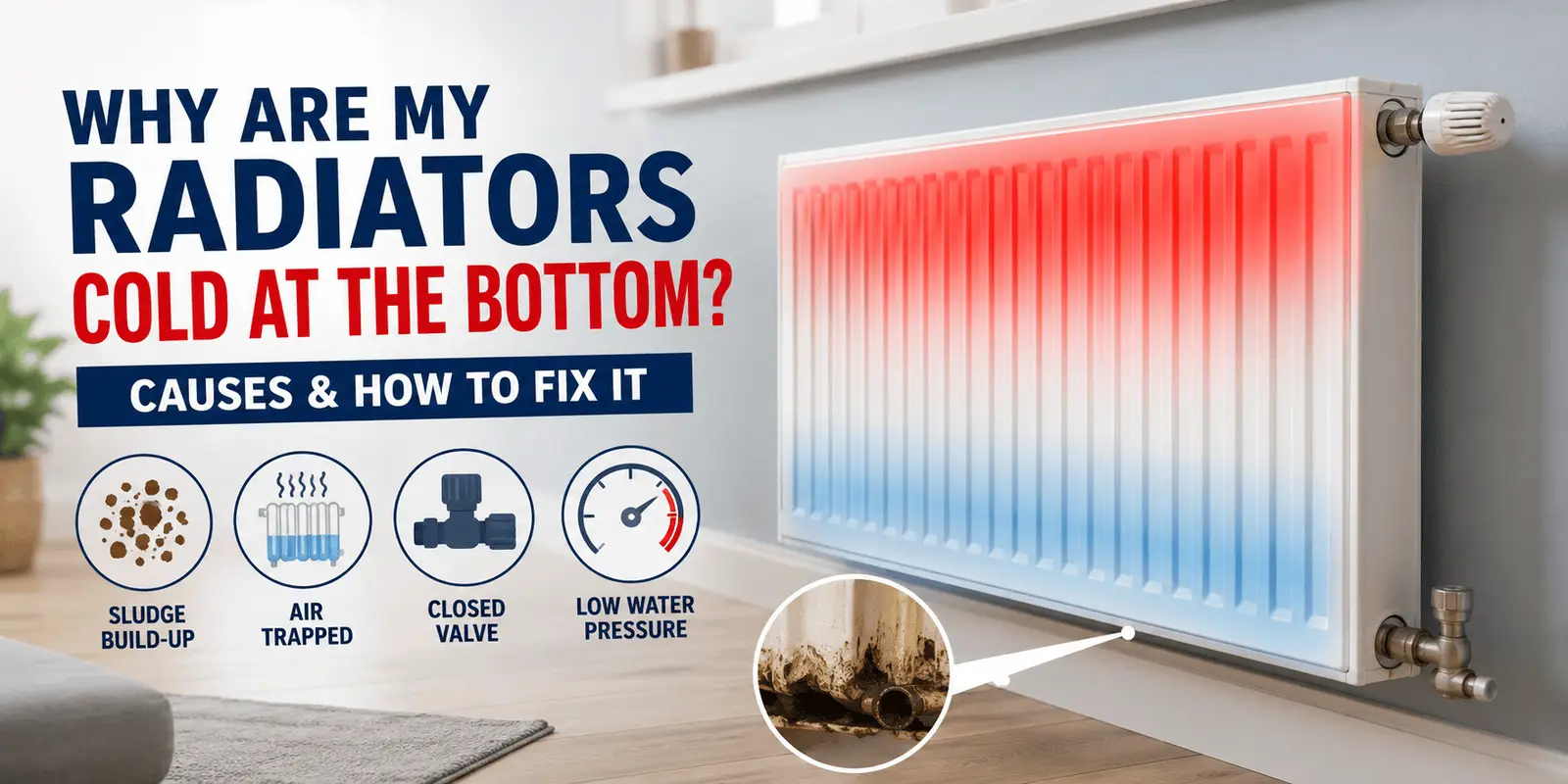
Is one of your radiators warm at the top but cold at the bottom? Or does the whole radiator seem to be underperforming even though your boiler is running? You are not alone. Radiators cold at the bottom is one of the most common central heating complaints we hear from homeowners across Coventry, Nuneaton, Warwick, Leamington Spa, and Rugby, and the good news is that it is almost always fixable.
In this guide, the Gas Safe registered engineers at Cathedral Gas Services walk you through every likely cause, how to diagnose the problem yourself, what you can do at home, and when you need a professional power flush or heating engineer to step in.
Quick Answer
Radiators cold at the bottom are almost always caused by a build-up of radiator sludge (magnetite) settling at the base of the radiator and blocking hot water from circulating freely. The fix is usually a power flush or a chemical flush carried out by a qualified heating engineer.
To understand why your radiator is not heating up properly, it helps to know the basics. Your boiler heats water and pumps it through a network of pipes. That hot water travels into each radiator, flows around the internal channels, gives off heat to the room, and returns to the boiler to be reheated.
A properly functioning radiator should feel consistently warm from top to bottom, slightly hotter at the top where water enters, but never cold at the base. When the bottom of a radiator stays cold while the top is warm, something is physically blocking or restricting the flow of water in the lower section.
Radiator sludge, also called magnetite or black sludge — is the number one reason for a radiator not heating up at the bottom. Over time, metal pipes and radiators corrode. This corrosion produces rust particles that circulate with the heating water. As the particles travel around the system, they clump together and form a dense, mud-like sludge.
Because sludge is heavier than water, it naturally settles at the lowest point — the bottom of your radiators. Once enough sludge accumulates, it creates a physical barrier that stops hot water from reaching the lower section of the radiator. The top stays warm (because water can still enter from above) but the bottom remains cold.
Signs You Have Radiator Sludge
Trapped air inside a radiator prevents hot water from filling the entire unit. Air pockets typically settle at the top of a radiator, which is why a radiator that is cold at the top is usually an air issue. However, if large amounts of air are circulating through the system, they can disrupt water flow to the lower sections as well.
Unlike sludge, trapped air is a straightforward DIY fix, you just need to bleed the radiator. However, if bleeding does not restore heat to the bottom, sludge is almost certainly the underlying problem.
The TRV controls how much hot water flows into the radiator. If the pin inside the TRV seizes, particularly common in radiators left untouched over summer, it can partially or fully block the water supply, leaving the radiator cold throughout, but especially at the bottom where flow is already weakest.
You can check this yourself: remove the TRV head and press the pin with your finger. It should move freely up and down. If it is stuck down or will not spring back, you have found your culprit. A gentle wiggle or application of WD-40 can sometimes free a stuck pin, but a persistently jammed valve will need replacing.
Homeowners in hard water areas, which includes parts of the West Midlands, face an additional challenge: limescale. Calcium and magnesium deposits from hard water can narrow pipes and internal radiator channels over time, reducing water flow and causing cold spots, particularly at the bottom where deposits settle.
Limescale build-up compounds the sludge problem because the rough surfaces created by limescale give magnetite particles more places to cling to.
If your downstairs radiators are cold but the upstairs ones are hot, you may have a balancing issue. Hot water naturally rises, so if the system is not correctly balanced, meaning the flow to each radiator is not calibrated, some radiators will receive less hot water than others. This is fixed by adjusting the lockshield valves on each radiator.
If multiple radiators are partially cold, check your boiler pressure gauge. Most combi boilers should operate between 1 and 1.5 bar. Below 1 bar, there is not enough pressure to push water effectively to all radiators. A faulty circulation pump can also cause similar symptoms, reducing flow to the farthest or lowest radiators first.
Use this table to identify your problem at a glance:
|
Symptom |
Likely Cause |
Fix |
|
Cold at the bottom only |
Sludge / magnetite build-up |
Power flush or radiator flush |
|
Cold at the top only |
Trapped air |
Bleed the radiator |
|
Completely cold |
Stuck TRV pin / closed valve |
Free pin / open valve |
|
Cold downstairs only |
Imbalanced system |
Radiator balancing |
|
Cold patches throughout |
Low boiler pressure / pump fault |
Check pressure / call engineer |
If you suspect trapped air, bleeding your radiator is the first step. Here is how to do it safely:
Let the system cool completely before you start, this prevents scalding from hot water. |
It is the small square or slotted valve at the top corner of the radiator, usually with a plastic cap. |
Place a cloth beneath the valve to catch any drips. |
Turn it anticlockwise slowly, just a quarter turn. You will hear a hissing sound as air escapes. |
Once water begins to trickle out steadily (and no more hissing), close the valve clockwise. |
Bleeding can drop the pressure. Repressurise the system if it falls below 1 bar. |
Turn the heating back on and check if the bottom of the radiator now heats up. |
Important Note
Bleeding fixes trapped air, it will NOT fix a radiator cold at the bottom caused by sludge. If bleeding does not work, proceed to the power flush options below.
If the TRV pin is jammed, try this:
A power flush is the most effective solution when radiator sludge is the cause of your radiators not heating up. This is not a DIY job — it requires specialist equipment and should be carried out by a qualified Gas Safe registered engineer.
During a power flush, a high-powered pump is connected to your central heating system. A combination of water and specialist cleaning chemicals is forced through the pipes, radiators, and boiler at high velocity. This dislodges sludge, magnetite, limescale, and debris, flushing them out of the system entirely.
What Does a Power Flush Involve?
After a power flush, homeowners typically notice an immediate improvement in heating efficiency, rooms heat faster, radiators are warm throughout, and energy bills often reduce.
For systems with moderate sludge build-up, a chemical flush (sometimes called a system flush) may be sufficient. This involves adding a cleaning chemical to the system and running it for a period before draining and refilling. It is less powerful than a full power flush but can be effective for mild cases.
If your problem is an imbalanced system rather than sludge, a heating engineer can balance the radiators by adjusting the lockshield valves on each radiator. This redistributes water flow evenly throughout the system so every room heats correctly.
Cathedral Gas Services are Gas Safe registered engineers specialising in power flushing, radiator servicing, and central heating across Coventry, Nuneaton, Warwick, Leamington Spa & Rugby. Get a free, no-obligation quote today.
How to Prevent Radiator Sludge in the Future
Once you have resolved the immediate problem, protecting your system from future sludge build-up will save you money and extend the life of your boiler and radiators.
Some heating issues are safe to tackle yourself — bleeding a radiator and freeing a TRV pin are both reasonable DIY tasks. However, you should always call a qualified Gas Safe registered engineer if:
Cathedral Gas Services is a Gas Safe registered heating company based in Coventry with over 10 years of experience and 5,000+ happy clients. Our engineers cover Coventry, Nuneaton, Warwick, Leamington Spa, and Rugby, providing:
All our work is fully Gas Safe certified and covered by our workmanship guarantee. We provide honest, upfront pricing with no hidden call-out charges.
Not sure what is wrong with your radiators? Call Cathedral Gas Services and we will diagnose the problem quickly — often the same day.
Find answers to common questions about our services
This is almost always caused by radiator sludge — a build-up of rust, magnetite, and debris that settles at the base of the radiator and prevents hot water from circulating fully. The fix is usually a power flush carried out by a Gas Safe registered engineer.
No. Bleeding a radiator releases trapped air, which causes cold at the top — not the bottom. If your radiator is cold at the bottom, bleeding is unlikely to help. You will probably need a power flush or chemical flush to remove sludge.
A professional power flush typically takes between 6 and 10 hours, depending on the size of your heating system and the severity of the sludge build-up. A qualified heating engineer will advise on the exact time once they have assessed your system.
Power flush costs in the Coventry area typically range from £300 to £600 depending on the number of radiators and the condition of the system. Cathedral Gas Services offers free, no-obligation quotes — call 07389 111 999 for an accurate price.
No. A power flush requires specialist equipment (a high-powered pump and flushing machine) and should only be carried out by a qualified Gas Safe registered engineer. Attempting it without proper training risks damaging your boiler and pipework.
Most heating engineers recommend a power flush every 5 to 8 years, or whenever radiators show signs of sludge build-up. Installing a magnetic filter after a flush can significantly extend the time between flushes.
Radiator sludge (magnetite) is primarily made up of corroded iron and steel particles from inside your pipes and radiators, combined with limescale and other debris. Over time, these particles clump together into a thick, dark sludge that settles at the bottom of radiators.
If your radiators are old (15+ years), severely corroded, or physically damaged, replacement may be more cost-effective than a flush. However, if they are structurally sound, a power flush can restore performance to near-new levels. A Gas Safe engineer can advise on the best option for your system.